

What Are Yellow Test Tubes For In Blood Draws

A range of Vacutainer tubes containing blood
A Vacuum blood collection tube is a sterile glass or plastic examination tube with a colored rubber stopper creating a vacuum seal inside of the tube, facilitating the drawing of a predetermined volume of liquid. Vacutainer tubes may incorporate additives designed to stabilize and preserve the specimen prior to analytical testing. Tubes are bachelor with a rubber-engineered stopper, with a variety of labeling options and depict volumes. The color of the height indicates the additives in the vial.[one]
Vacutainer tubes were invented by Joseph Kleiner and Becton Dickinson in 1949.[2] Vacutainer is a registered trademark of Becton Dickinson, which manufactures and sells the tubes today.[3] [4]
Principles [edit]
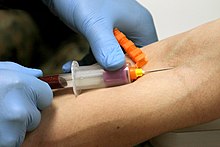
Drawing blood using a vacutainer. The clear plastic sheath around the top of the tube holds the needle. The orange guard volition shield the needle after it is withdrawn from the patient to protect from adventitious needle sticks.
The Vacutainer needle is double-ended: the inner stop is encased in a sparse rubber coating that prevents claret from leaking out if the Vacutainer tubes are changed during a multi-depict, and the outer end which is inserted into the vein. When the needle is screwed into the translucent plastic needle holder, the coated end is within the holder.
When a tube is inserted into the holder, its safety cap is punctured by this inner needle and the vacuum in the tube pulls blood through the needle and into the tube. The filled tube is then removed and another can be inserted and filled the same way. The amount of air evacuated from the tube predetermines how much claret will fill the tube before blood stops flowing.
Each tube is topped with a colour-coded plastic or safe cap. Tubes often include additives that mix with the blood when collected, and the colour of each tube's plastic cap indicates which additives it contains.
Blood drove tubes elapse because over fourth dimension the vacuum is lost and blood will not be drawn into the tube when the needle punctures the cap.
Types of tubes [edit]

A tiger top tube after centrifugation to separate blood cells from serum
Vacutainer tubes may contain additional substances that preserve blood for processing in a medical laboratory. Using the incorrect tube may make the blood sample unusable for the intended purpose. These additives are typically thin motion-picture show coatings applied using an ultrasonic nozzle.
The additives may include anticoagulants (EDTA, sodium citrate, heparin) or a gel with density between those of claret cells and blood plasma. Additionally, some tubes contain additives that preserve sure components of or substances within the blood, such as glucose. When a tube is centrifuged, the materials within are separated by density, with the blood cells sinking to the bottom and the plasma or serum accumulating at the top. Tubes containing gel tin can be easily handled and transported later on centrifugation without the blood cells and serum mixing.

The meanings of the various colors are standardized across manufacturers.[5] [half dozen] [7]
The term order of draw refers to the sequence in which tubes should be filled. The needle which pierces the tubes can carry additives from ane tube into the next, and then the sequence is standardized and then that whatsoever cross-contamination of additives will not impact laboratory results.[7]
| Tube cap color or type | Additive | Usage and comments |
|---|---|---|
| Blood culture bottle | Sodium polyanethol sulfonate (anticoagulant) and growth media for microorganisms | Usually drawn first for minimal risk of contagion.[eight] Ii bottles are typically collected in i blood draw; one for aerobic organisms and one for anaerobic organisms.[9] |
| Light blue | Sodium citrate (anticoagulant) | Coagulation tests such as prothrombin time (PT) and partial thromboplastin time (PTT) and thrombin time (TT). Tube must be filled 100%. |
| Plain ruby-red | No additive | Serum: Total complement activity, cryoglobulins |
| Gold (sometimes ruby-red and greyness "tiger top"[x]) | Clot activator and serum separating gel[eleven] | Serum-separating tube: Tube inversions promote clotting. Most chemistry, endocrine and serology tests, including hepatitis and HIV. |
| Dark green | Sodium heparin (anticoagulant) | Chromosome testing, HLA typing, ammonia, lactate |
| Mint dark-green | Lithium heparin (anticoagulant) | Plasma. Tube inversions prevent clotting |
| Lavender ("purple") | EDTA (chelator / anticoagulant) | Whole blood: CBC, ESR, Coombs test, platelet antibodies, flow cytometry, blood levels of tacrolimus and cyclosporin |
| Pink | EDTA (chelator / anticoagulant) | Blood typing and cross-matching, directly Coombs test, HIV viral load |
| Regal blue | EDTA (chelator / anticoagulant) | Trace elements, heavy metals, most drug levels, toxicology |
| Tan | EDTA (chelator / anticoagulant) | Lead |
| Gray |
| Glucose, lactate[xiii] |
| Yellowish | Acid-citrate-dextrose A (anticoagulant) | Tissue typing, Dna studies, HIV cultures |
| Pearl ("white") | Separating gel, cumb and (K2)EDTA | PCR for adenovirus, toxoplasma and HHV-6 |
History [edit]

Blood collection tubes are amid the bones medical supplies taken by disaster relief programs to affected areas.
Vacutainer technology was developed in 1947 by Joseph Kleiner,[2] and is currently marketed by Becton Dickinson (B-D).[xiv] The Vacutainer was preceded past other vacuum-based phlebotomy engineering such as the Keidel vacuum.
The plastic tube version, known as Vacutainer PLUS, was adult at B-D in the early 1990s by East. Vogler, D. Montgomery and G. Harper amongst others of the Surface Science Group as US patents 5344611, 5326535, 5320812, 5257633 and 5246666.[15]
Vacutainers are widely used in phlebotomy in developed countries due to safety and ease of use. Vacutainers have the advantage of being prepared with additives, allowing easy multi-tube draws, and having a lower chance of hemolysis.[xvi] In developing countries, it is still common to draw blood using a syringe or syringes.
References [edit]
- ^ "Vacutainer and Their Use in Blood Sampling". medcaretips.com. 5 February 2018. Retrieved 27 May 2020.
- ^ a b Rosenfeld L (2000). "A golden historic period of clinical chemistry: 1948–1960". Clin Chem. 46 (10): 1705–14. doi:10.1093/clinchem/46.10.1705. PMID 11017957.
- ^ "VACUTAINER - Trademark Details". Justia. Justia Corporate Center. 2020. Retrieved February 9, 2020.
- ^ "BD Vacutainer®". BD. Becton Dickinson. 2020. Retrieved February 9, 2020.
- ^ "Specimen Collection Tubes & Containers". Archived from the original on 2006-02-12. Retrieved 2006-02-01 .
- ^ "Quick Collection List". Archived from the original on 2005-12-16. Retrieved 2006-02-01 .
- ^ a b "Blood collection: routine venipuncture and specimen treatment". Retrieved 2006-02-01 .
- ^ Pagana, KD; Pagana, TJ; Pagana, TN (19 September 2014). Mosby'south Diagnostic and Laboratory Test Reference - E-Book. Elsevier Health Sciences. p. thirteen. ISBN978-0-323-22592-two.
- ^ "Chapter 3.4.1: Claret cultures; general detection and interpretation". Clinical Microbiology Procedures Handbook. Wiley. 6 August 2020. ISBN978-1-55581-881-4.
- ^ "Test Tube Guide and Gild of Draw" (PDF). Guthrie Laboratory Services. June 2019.
{{cite web}}: CS1 maint: url-condition (link) - ^ "Specimen requirements/containers". Pathology & Laboratory Medicine, UCI School of Medicine . Retrieved 2020-09-10 .
- ^ Castellini MA, Castellini JM, Kirby VL (1992). "Effects of standard anticoagulants and storage procedures on plasma glucose values in seals". J Am Vet Med Assoc. 201 (1): 145–8. PMID 1644639.
- ^ Amitava Dasgupta; Jorge L. Sepulveda (20 July 2019). Accurate Results in the Clinical Laboratory: A Guide to Error Detection and Correction. Elsevier Scientific discipline. p. 131. ISBN978-0-12-813777-ii.
- ^ "BD Vacutainer Venous Blood Drove – Tube Guide" (PDF) . Retrieved 2007-05-30 .
- ^ "U.s.a. Patent Office Patent number search".
- ^ Ames, A.C.; Bamford, East. (1975). "An Appraisal of the "Vacutainer" System for Claret Drove". Annals of Clinical Biochemistry. 12 (1–half dozen): 151–55. doi:10.1177/000456327501200136. PMID 15637911.
External links [edit]
- Animated Vacutainer Procedure with Order of Draw
- Blood Collection Tube Coating Video

Source: https://en.wikipedia.org/wiki/Vacutainer
Posted by: johnsonequallown.blogspot.com
0 Response to "What Are Yellow Test Tubes For In Blood Draws"
Post a Comment